Serena Williams Super Bowl LX Commercial 'Healthier on Ro.'


THE POSITION
Ro turned strength into permission to get help.
Weight-loss marketing has traditionally sold transformation through what the body can become. Ro chose someone whose body already signifies achievement, discipline and strength.
Serena Williams changes the argument. Her value isn't simply that she's famous or physically powerful. It's that decades of elite performance make lack of effort almost impossible to blame.
Ro isn't using strength to sell harder work.
It's using strength to remove the shame from needing help.
01 — THE MOVE
Choose the athlete who makes “try harder” impossible.
Ro could have built its GLP-1 campaign around a dramatic before-and-after transformation. Instead, it put one of the world's most accomplished athletes at the center.
That's the strategic choice.
Serena represents discipline before Ro ever enters the story. Twenty-three Grand Slam singles titles, years of elite conditioning and an identity inseparable from physical strength give the campaign something advertising cannot manufacture: proof that effort and biology aren't the same thing.
Ro therefore changes what Serena is endorsing. She isn't simply evidence that GLP-1s can help someone lose weight.
She is evidence that needing help does not mean someone failed to work hard enough.

02 — THE THINKING
Strength makes treatment easier to accept.
The barrier surrounding GLP-1s isn't only whether they work. It's what taking one can mean about the person taking it.
The language of weight has long been entangled with discipline: eat better, exercise more, try harder. Ro deliberately puts that assumption against someone whose career makes extraordinary discipline self-evident. Its own explanation of the partnership is remarkably direct: Serena was doing the work, yet after pregnancy her body wasn't responding as it once had. Ro positions biology—not insufficient effort—as the unresolved problem.
That's where your observation about her physique becomes important.
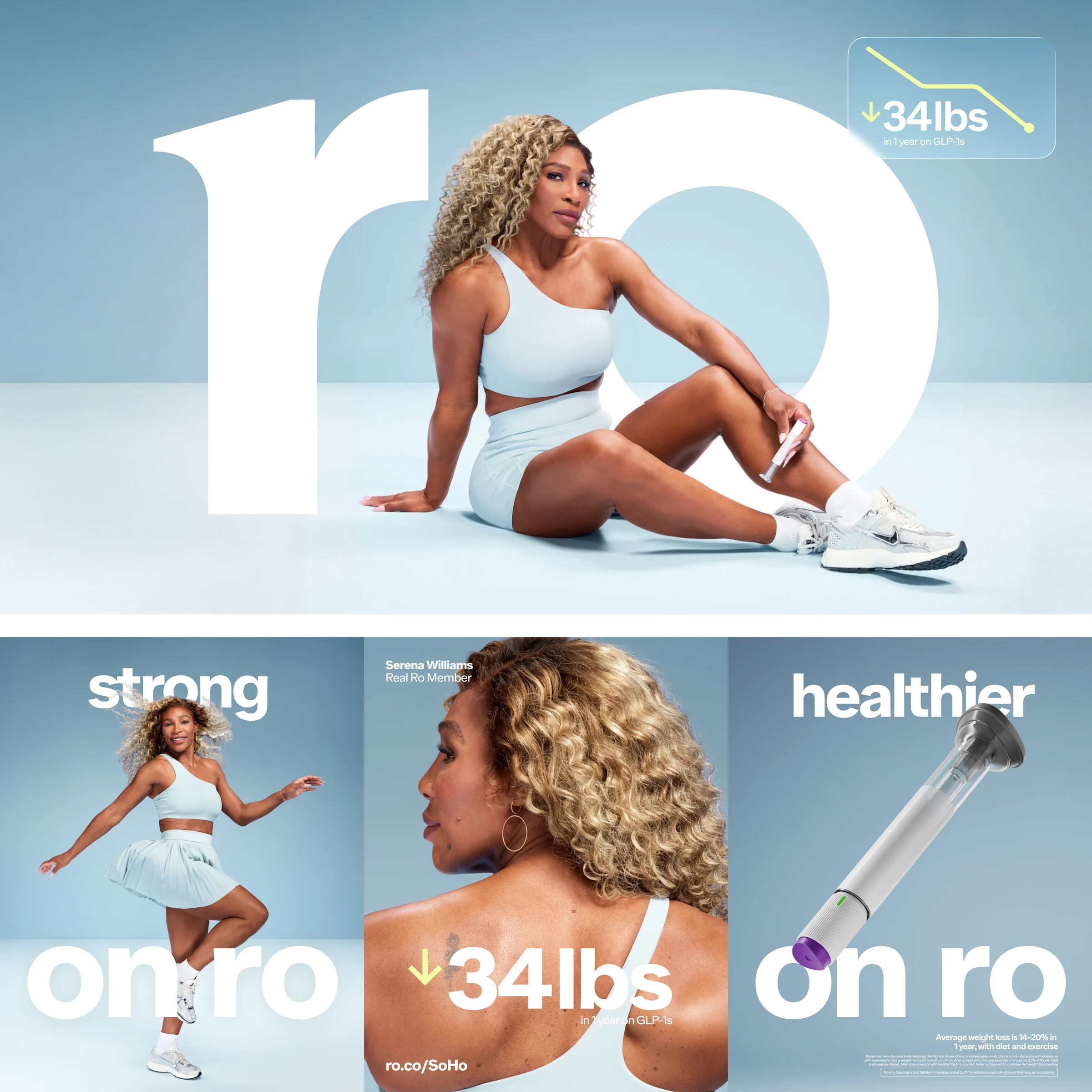
The campaign doesn't erase Serena's strength to reveal a smaller Serena. It keeps showing strength: jumping, moving, flexing, training, energy. The desired transformation becomes less about taking up less space and more about what the body can do and how it feels.
Serena gives treatment permission because strength existed before the medication.
The medicine isn't positioned as the substitute for effort. It's positioned as support when effort isn't enough.
03 — THE IMPACT
Ro can compete against stigma, not just other providers.
That distinction expands what Ro is selling.
The campaign still makes concrete weight-loss claims, but Healthier on Ro deliberately extends the story to blood sugar, cholesterol, joint stress, energy and overall health. Ro says Serena lost 34 pounds in a year and reports improvements in several health markers; the broader campaign similarly presents outcomes from other patients beyond the number on a scale.
That moves the competitive argument away from simply where do I get a GLP-1? toward what does getting medical help say about me?
Serena gives Ro a culturally powerful answer: treatment and strength don't have to contradict each other.
Ro isn't asking people to become Serena. It's using Serena to make getting help feel compatible with becoming stronger.

Sources
Ro — “Ro Debuts First-Ever Super Bowl Commercial Starring Serena Williams to Launch ‘Healthier on Ro’ Campaign”
Primary campaign announcement establishing the January 28, 2026 launch, Serena’s role, campaign scope, health outcomes and Ro’s stated purpose of expanding the GLP-1 conversation beyond weight loss.
View Source →
Ro — “The Making of Ro’s First Super Bowl Ad”
The strongest strategy source. Ro explains that the earlier Serena work challenged the idea that GLP-1s are “cheating,” while Healthier on Ro addresses the belief that weight-loss medication is only about vanity. It also documents the 150+ concepts considered, creative development, Ro In-House team and production partners.
View Source →
Ro — “Serena’s on Ro!”
Establishes the strategic foundation of the Serena partnership: despite elite training and discipline, Williams said her body responded differently after pregnancy. Ro explicitly positions her story as evidence that weight management involves biology rather than willpower alone.
View Source →
Young Hero — “Ro Super Bowl LX”
Production-partner documentation of the campaign, describing how the original Serena narrative was expanded into Healthier on Ro across television, digital and out-of-home, with patient stories supporting the broader health proposition.
View Source →
Reuters — “Weight-loss drugs to compete on biggest stage with Super Bowl ads”
Independent market context showing Ro entering an increasingly competitive GLP-1 advertising environment alongside Novo Nordisk, Eli Lilly and Hims & Hers, helping establish why differentiation around the meaning of treatment matters commercially.
View Source →

Written by
Ray Joseph
Founder, JOSEPH












.png)
