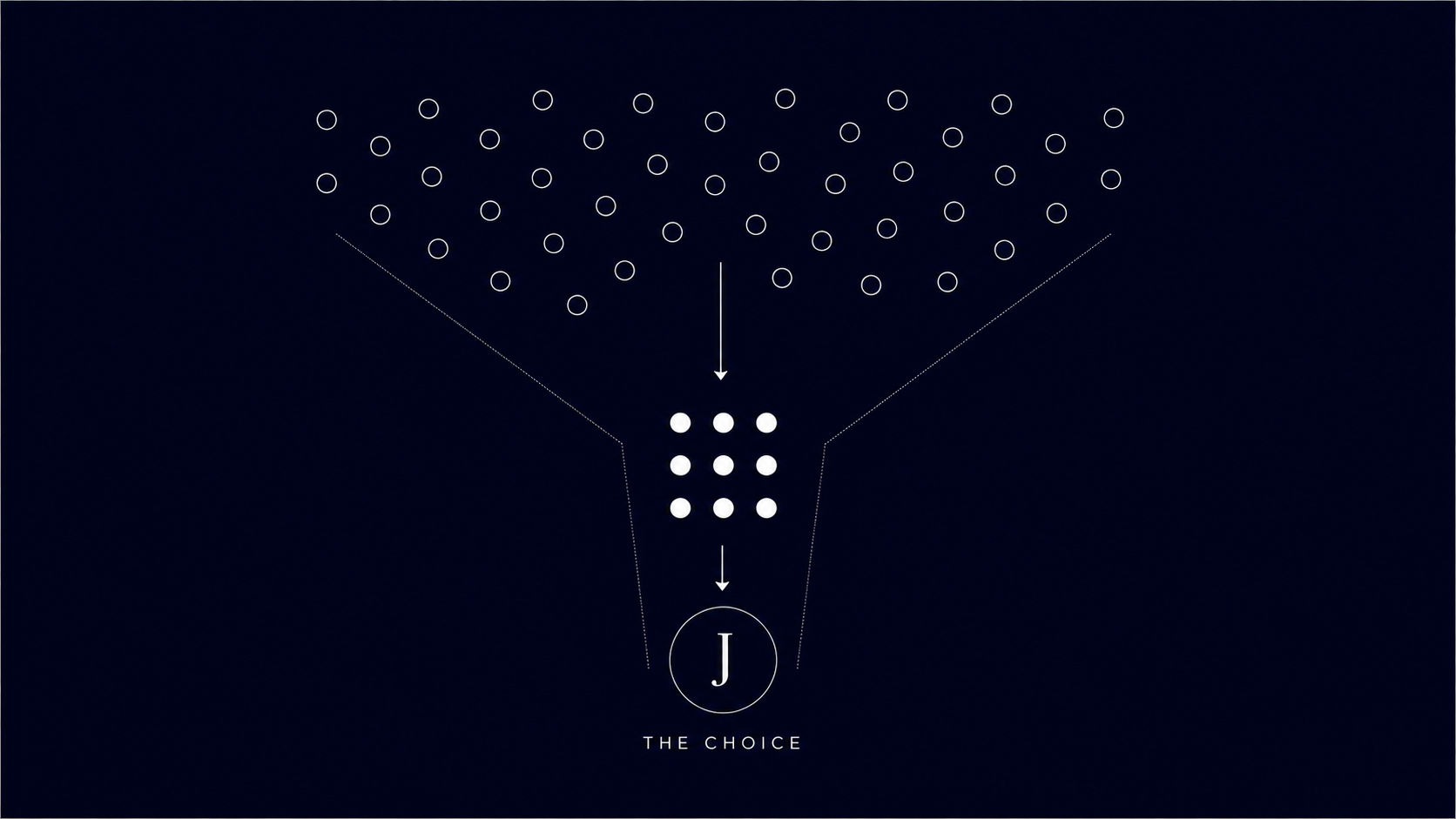
Understand the Customer You Intend to Win
Customer strategy determines who matters most, what they value, what influences their decisions, and how the brand can create greater relevance with them.
JOSEPH works with leadership to move beyond broad audiences and surface-level demographics to develop a clearer understanding of the customers the organization intends to win.
Because strategy becomes more precise when you know whose choice you are trying to influence.
Not Every Customer Matters Equally
Organizations often describe their customer too broadly.
They attempt to serve multiple audiences, respond to every opportunity, and build marketing around what the largest possible group of people might want.
The result can be more activity but less relevance.
Customer strategy requires focus.
It asks leadership to determine which customers matter most to the future of the business—and understand them well enough to make meaningful strategic choices.
Who Are You Trying to Win?
That is the fundamental customer strategy question.
Not simply who can buy from you?
But who matters most? What are they trying to accomplish? What do they value? What alternatives are they considering? What influences their decisions? What creates confidence? And ultimately, what makes them choose?
Understanding those answers gives the organization a stronger foundation for deciding how to compete.
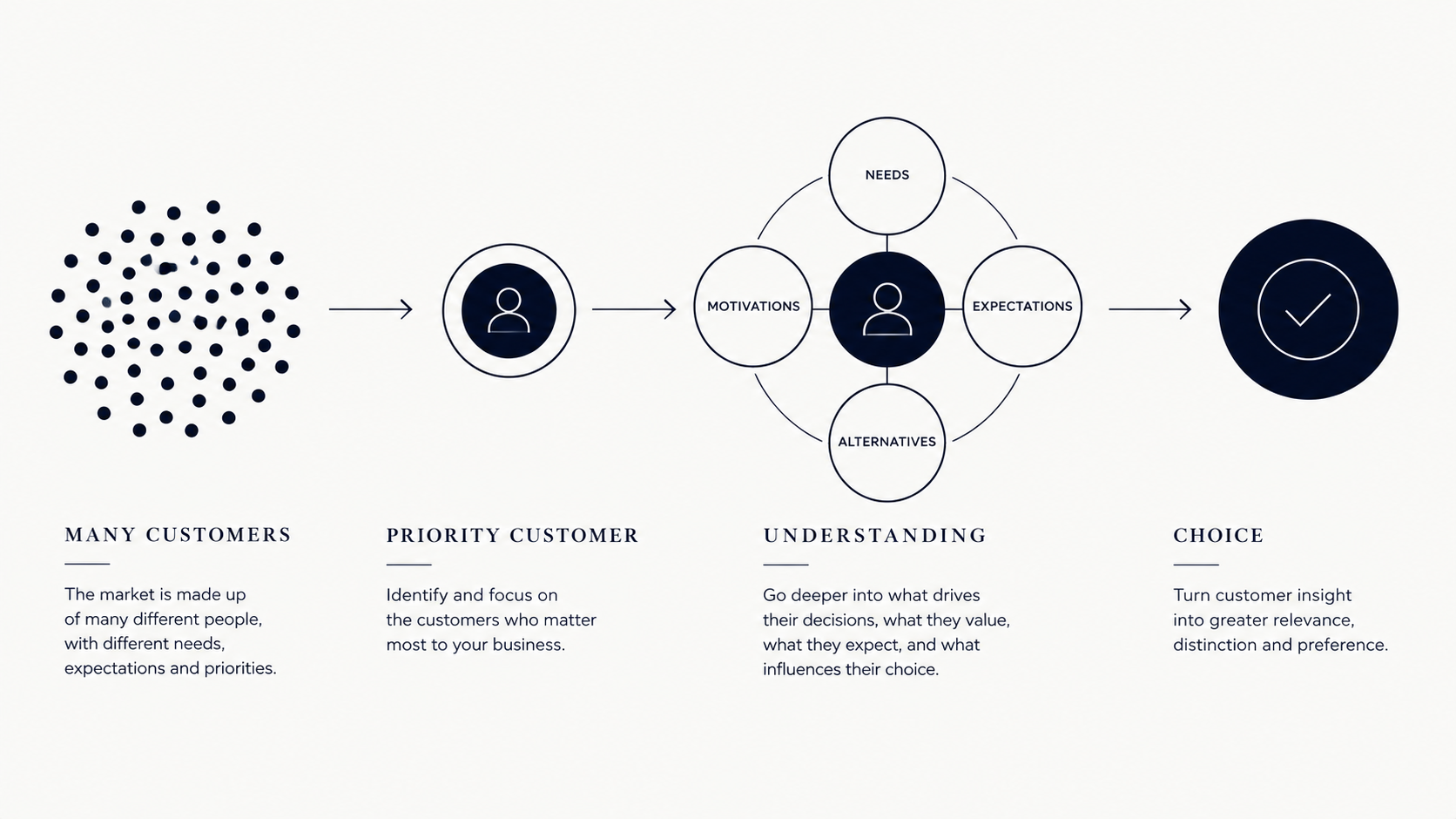
Understand What Drives Choice
Customers do not make decisions based solely on what a company wants to communicate.
They compare alternatives through their own priorities, expectations, perceptions, experiences, and circumstances.
That means understanding the customer requires looking beyond demographics and asking what actually drives preference and choice.
JOSEPH examines customer needs, behaviors, motivations, expectations, decision criteria, perceptions, barriers, and competitive alternatives to identify what matters enough to influence the decision.
The objective is not simply to know more about the customer.
It is to understand what the organization needs to know to make better strategic decisions.
Customer Strategy Requires Focus
A company can have many customers without every customer being equally important to its strategy.
Trying to create equal relevance for everyone often weakens the brand's ability to create meaningful relevance for anyone.
Customer strategy requires choices about who to prioritize, which needs matter most, what expectations must be met, and where the organization has the strongest opportunity to create value.
Those choices create focus.
And focus allows the organization to concentrate its attention and resources around the customers most important to where the business is going.
Turn Customer Understanding Into Direction
Customer insight only becomes valuable when it changes a decision.
It should influence positioning, value propositions, product priorities, experiences, communications, channels, go-to-market decisions, and where the organization invests its resources.
When leadership understands who matters and what drives their decisions, it has a better standard for deciding what to offer, what to emphasize, where to engage, what experience to create, and what deserves priority.
That is when customer understanding becomes customer strategy.
Become More Relevant to the Customers Who Matter
The objective is not simply to understand customers better.
It is to use that understanding to make the brand more relevant, more distinctive, and more likely to be chosen by the customers that matter most.
JOSEPH translates customer understanding into strategic direction leadership can use: a clearer understanding of who to prioritize, what matters to them, what influences their decisions, and where the brand has an opportunity to create greater relevance.


For better decisions.

UPSTREAM
JOSEPH works on the decisions that determine what execution should do before campaigns, creative, media, and channels are put into motion.

EXPERIENCED
Our perspective is informed by firsthand experience building campaigns, customer journeys, acquisition systems, and growth programs.

SENIOR-LED
Clients work directly with the people responsible for the strategy—not through layers of account management.

FOCUSED
JOSEPH focuses on strategic marketing decisions: positioning, customers, competition, and growth.

We work alongside leadership, internal teams, and agency partners—bringing strategic direction without disrupting the people responsible for execution.

PRACTICAL
The work doesn't end with a presentation. Strategy should create clear choices, priorities, and direction people can actually act on.
01 — What exactly does JOSEPH help companies do?


JOSEPH helps companies make better marketing decisions. We work with leadership to understand where the brand stands, identify what matters most, and develop the positioning, priorities, and strategic direction needed to move forward with greater clarity.
02 — Who does JOSEPH work with?
We work with companies and leadership teams facing important questions about their brand, market, customers, positioning, or growth. Our work can support established organizations, growing companies, and leadership teams navigating change, competition, or a new stage of growth.
03 — When should a company hire JOSEPH?
Usually when the answer is not simply “do more marketing.” A company may have capable people, agencies, technology, and resources but still lack clarity around what it should prioritize, how it should position itself, or where its greatest opportunity lies. That is where strategy becomes valuable.
04 — How is JOSEPH different from a marketing agency?
Marketing agencies are generally built to execute. JOSEPH is built to advise.
We work upstream of execution—helping leadership determine the positioning, priorities, choices, and strategic direction that should guide the marketing. Once that direction is established, internal teams and agency partners can execute against a clearer strategy.
05 — What types of problems does JOSEPH help solve?
We help leadership address questions involving positioning, differentiation, customers, competition, brand direction, growth priorities, go-to-market decisions, marketing effectiveness, and where resources should be focused.
The specific problem may differ, but the objective remains the same: reduce complexity and create strategic clarity.
06 — What does a typical consulting engagement look like?
Every engagement begins with understanding the situation before recommending a direction. We examine the business, market, customer, competition, existing marketing, internal assumptions, and the decisions leadership is facing.
From there, JOSEPH develops the strategic recommendations, priorities, and direction appropriate to the engagement. Depending on the need, our involvement may continue through ongoing advisory as decisions are made and the strategy moves forward.
The specific problem may differ, but the objective remains the same: reduce complexity and create strategic clarity.
07 — Does JOSEPH offer marketing execution?
No. JOSEPH intentionally does not sell marketing execution.
Our independence is important to the integrity of our advice. We do not make money from advertising spend, media placement, websites, creative production, technology platforms, or the partners we recommend. We have no financial incentive to recommend one tactic, vendor, channel, or solution over another.
That allows us to make recommendations based on what we believe is right for the client and the brand—not what creates additional revenue for JOSEPH.
From there, JOSEPH develops the strategic recommendations, priorities, and direction appropriate to the engagement. Depending on the need, our involvement may continue through ongoing advisory as decisions are made and the strategy moves forward.
The specific problem may differ, but the objective remains the same: reduce complexity and create strategic clarity.
Our incentive is the success and growth of the brands we advise.
08 — Does JOSEPH make money from its recommendations?
No. JOSEPH does not accept commissions, referral fees, media percentages, or other financial incentives tied to the recommendations we make.
If we recommend an agency, platform, partner, channel, or investment, the recommendation is made because we believe it serves the strategy and the client's interests.
09 — Can JOSEPH work with our existing agency or internal marketing team?
Yes. In many engagements, that is exactly how we work.
JOSEPH can provide the strategic direction while internal teams and specialist partners bring that direction to life. We are not there to unnecessarily replace capable partners. We help leadership establish clarity and help the people responsible for execution understand the strategy they are executing against.
10 — How long does an engagement typically last?
It depends on the problem being solved and the scope of the work. Some strategic engagements are defined projects with a clear beginning and conclusion. Others develop into longer advisory relationships as leadership continues making decisions and implementing the strategy.
We define the scope, responsibilities, timing, and expected outcomes before an engagement begins.
11 — Does JOSEPH offer ongoing advisory?
Yes. Advisory provides leadership with continued access to senior strategic counsel after—or independently of—a defined strategy engagement.
This can include evaluating opportunities, reviewing marketing decisions, challenging assumptions, advising on priorities, working with agency partners, and helping leadership maintain strategic alignment as conditions change.
12 — How much does it cost to work with JOSEPH?
Fees depend on the complexity of the problem, scope of the engagement, level of involvement required, and duration of the work.
After an initial conversation, JOSEPH recommends an appropriate engagement structure and provides a clear scope and fee before work begins.
13 — Does JOSEPH work with clients outside California?
Yes. JOSEPH can work with organizations and leadership teams regardless of location. Engagements can be conducted remotely, in person, or through a combination of both depending on the needs of the work.
14 — Does JOSEPH specialize in a particular industry?
Our work is centered on strategic marketing problems rather than a single industry. The underlying questions—how to compete, what customers value, where a brand should position itself, what to prioritize, and how to become the preferred choice—exist across categories.
When specialized industry expertise is necessary, we account for that as part of the engagement.
15 — How do we know if JOSEPH is the right fit?
The first conversation is designed to determine exactly that.
We want to understand the problem, what leadership is trying to accomplish, what has already been tried, and whether strategic consulting can meaningfully help. If JOSEPH is not the right answer, we would rather say so than create an engagement that should not exist.
16 — How do we get started?
Start with a conversation.
Tell us where the business stands, where you are trying to go, and what is making that difficult. We will determine whether JOSEPH can help and, if so, recommend the appropriate next step.
Proven Expertis
Our team of seasoned legal experts brings extensive knowledge and experience to navigate complex regulatory challenges effectively.
Proven Track Record
Our team of seasoned legal experts brings extensive knowledge and experience to navigate complex regulatory challenges effectively.
Tailored Approach
Our team of seasoned legal experts brings extensive knowledge and experience to navigate complex regulatory challenges effectively.
Integrity
Our team of seasoned legal experts brings extensive knowledge and experience to navigate complex regulatory challenges effectively.
Dedication to Excellence
Our team of seasoned legal experts brings extensive knowledge and experience to navigate complex regulatory challenges effectively.
Real Results
Our team of seasoned legal experts brings extensive knowledge and experience to navigate complex regulatory challenges effectively.
.png)